
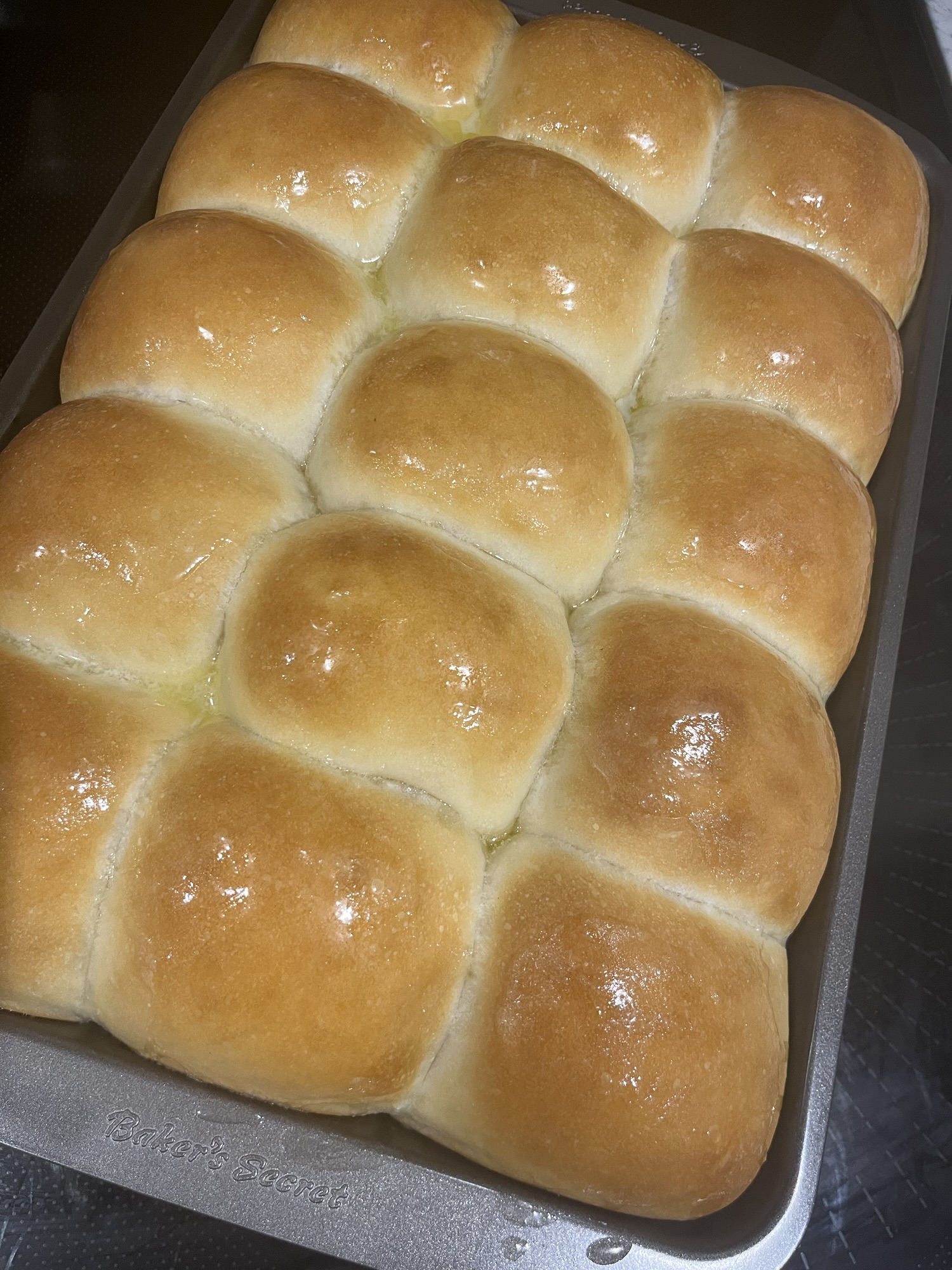
If you’ve been looking for a truly soft, fluffy, classic dinner roll made with 100% sourdough—this is the one. These rolls are enriched, buttery, and lightly sweet, but without the tang you typically get from long-fermented sourdough. The secret? A sweet stiff starter. It gives you all the rise and strength of sourdough while keeping the flavor mild, making these rolls perfect for holidays, Sunday dinner, or any night you want to level up your meal. They’re also perfect for picky eaters. My kids all ate them and loved them and didn’t even know they were sourdough.
If you do prefer a bit of tang, just swap the sweet stiff starter for your regular 100% hydration sourdough starter. Both versions rise beautifully—the flavor is the only real difference. You may need to add a little extra flour if you use a 100% hydration sourdough starter.


The real key to amazing sourdough rolls is patience and warm dough. I kept my dough around 80°F, and it doubled in about 4 hours, then doubled again after shaping in about 3 hours. If your kitchen or dough is cooler, don’t stress. Sourdough always works on its own timeline—just give it the time it needs, and you’ll be rewarded with the softest rolls ever. Push the second rise as long as you can. Honestly, it’s better to over proof them than underproof them.
This recipe makes 15 rolls, and I promise: once you make them, they’ll become your go-to.

Ingredients
- Active sweet stiff starter – Leavens your bread without the tang!
- Honey – Adds just the right touch of sweetness and helps the rolls brown beautifully.
- Unsalted Butter – Makes the rolls soft, tender, and rich.
- Egg – Adds structure and extra softness.
- Salt – Enhances flavor and strengthens the dough.
- Bread Flour – Gives the dough strength and helps the rolls rise tall and fluffy.
- Water – Hydrates the dough and brings everything together.
Equipment
- Stand Mixer (optional) – A mixer makes kneading enriched sourdough dough much easier, but you can absolutely make these by hand.
- Mixing Bowl & Dough Whisk – Perfect for hand mixing.
- Kitchen Scale – Essential for accurate measurements in sourdough baking.
- 9×13 Baking Pan – The ideal size for 15 rolls that bake up soft and pull-apart.
Why You’ll Love These Rolls
- 100% sourdough but not tangy thanks to the sweet stiff starter.
- Incredibly soft and fluffy, just like classic dinner rolls.
- Perfect for holidays, weeknight dinners, or making ahead for big gatherings.
- Flexible rise times—they’re ready when your dough is ready.
- Naturally fermented, giving you better texture, flavor, and digestibility.
Shaping Your Rolls

Portion out

Pinch into a ball

Roll ’em out
Sample same-day roll schedule:
| Day 1: 7 p.m. | Mix your sweet stiff start. Cover and place somewhere warm for the night. |
| Day 2: 7 a.m. | Mix up your dough. Cover and let raise until doubled in size. This will take about 4 hours if your dough is 80F. If your dough is cooler, this will take longer. |
| 11:30 a.m. | Shape your rolls. Place on a greased sheet pan. Cover and let raise until doubled in size. This will take about 3-4 hours if your dough is around 80F. If its cooler, this will take longer |
| 4:30 p.m. | Preheat oven to 350F |
| 5:00 p.m. | Bake your rolls |
| 5:30 p.m. | Dinner is served … with amazing, warm rolls on the side. |
Sample overnight proof schedule:
| Day 1: 9 p.m. | Mix your sweet stiff start. Cover and place somewhere warm for the night. |
| Day 2: 10 a.m. | Mix up your dough. Cover and let raise until doubled in size. This will take about 4 hours if your dough is 80F. If your dough is cooler, this will take longer. |
| 2 p.m. | Shape your rolls. Place on a greased sheet pan. Cover and place in fridge. |
| Day 3: 10 a.m. | Remove rolls from fridge and place in a warm spot in your kitchen. Let raise until rolls are doubled in size. This will take 5+ hours because your dough is cold from being in the fridge overnight. Do not rush this step of you will end up with dense rolls. |
| 5:00 p.m. | Bake your rolls |
| 5:30 p.m. | Dinner is served … with amazing, warm rolls on the side. |
Keeping Your Dough Warm:
If you want to be able to bake these rolls the same day, you need to keep your dough warm – like 80F if possible. Below are a few ways that you can keep your dough warm. (My favorite is using the microwave)
- Place proofing bowl on a seedling mat or a dough proofing mat
- Place proofing bowl in the oven with the light on. If your dough starts to get too warm, you can turn the light off or keep the door cracked open. Truthfully, this is my least favorite way to keep dough warm because I’ve been known to preheat the oven with dough proofing in it. So … just don’t bake your dough.
- Use warm water and warm milk
- Place on a fireplace mantle, on top of the dryer or on the refrigerator
- Fill a microwave safe measuring cup 3/4 way full of water. Warm the water for about 5 minutes. Then place your bowl of dough in the microwave next to the cup of hot water. Check on it every hour or two to make sure your dough isn’t getting too warm.

Sourdough Dinner Rolls

Equipment
- large mixing bowl and spoon OR stand mixer
- 9×13 pan
- Kitchen scale
Ingredients
Sweet Stiff Levain
- 25 g active starter
- 25 g granulated sugar
- 100 g all-purpose flour
- 50 g water
Roll Dough
- All of the sweet stiff levain (about 200 grams)
- 250 g water about 1 cup
- 135 g milk about ½ cup
- 56 g unsalted butter, melted 4 tablespoons
- 50 g honey
- 8 g salt
- 700 g bread flour
- 1 large egg
Instructions
Make the Sweet Stiff Levain
- About 10–12 hours before you want to mix your dough, make your sweet stiff levain. To do this combine your starter, sugar, flour and water and mix until everything is combined. This is a stiff starter, so you can knead everything together on the counter for a minute to make sure the ingredients are incorporated. Cover and set someplace warm until it hits peak, usually 10-12 hours.
Mix the Dough
- In a large mixing bowl or stand mixer, add the water, milk, melted butter, honey, egg, and salt to a mixing bowl and stir to combine. Add all of the sweet stiff levain to the liquid mixture. Stir or mix on low with a dough hook until the levain breaks down slightly. Add all but 50 grams of the bread flour and mix until a rough dough forms. Slowly add remaining flour until dough is tacky, but not overly sticky. You may need all the flour, you may not. Fluffy rolls begin with tacky dough.
Knead
- Continue mixing (or knead by hand) until the dough becomes smooth, elastic, and strong—about 8–10 minutes in a stand mixer. The dough should clean the sides of the bowl and feel slightly tacky.
- You'll know your dough is ready when it passes the window pane test. Gently pull a small section of dough up and stretch it. You should be able to see light coming through the dough without it tearing. It will eventually tear as you pull and stretch it, but you should be able to see a little light shining through. If it tears immediately when you stretch it out, you need to knead the dough longer to build more strength.
First Rise (Bulk Fermentation)
- Transfer the dough to a lightly oiled bowl and cover.
- Because this recipe is 100% sourdough, the rise is slow. At an average dough temperature of 75°F, the dough will need 5–6 hours to double. My dough took about 4 hours to double with a dough temperature at about 80 °FIf you want to speed things up, use warm water and warm milk to jump start fermentation. If you use cold water and cold milk, you can mix the dough before bed and let it rise overnight on the counter (about 10 hours), then shape and bake the next day.
Shape the Rolls
- Once doubled, turn the dough out onto a lightly floured surface. Divide into 15 equal pieces, about 95 grams, and shape each into a tight ball. Arrange the rolls in a greased 9×13-inch pan.
Second Rise (Proofing)
- Cover and let the rolls rise until very puffy and doubled—usually 5-6 hours, depending on temperature. The key to amazing texture is patience. Rushing will give you dense rolls. If you want to speed this process up, place your rolls someplace warm (around 78-80 °F). Colder dough will take much longer to proof. My rolls took about 3 hours to double in size with a dough temperature of about 80 °F*NOTE – If you want to bake the next day, shape them and place them in the fridge for the night. Then in the morning, remove them from the fridge and let them proof until they're double in size. Remember this will take longer because your dough has to come to room temperature and then begin to raise. Plan on 6+ hours.
Bake
- Preheat oven to 350°F.
- Bake for 20–24 minutes, or until the rolls are deep golden and baked through.
- Brush with melted butter if desired. Let Cool in the pan for about 10 minutes and then transfer to a wire cooling rack so the bottom of your rolls don't get soggy.
Leave a Reply