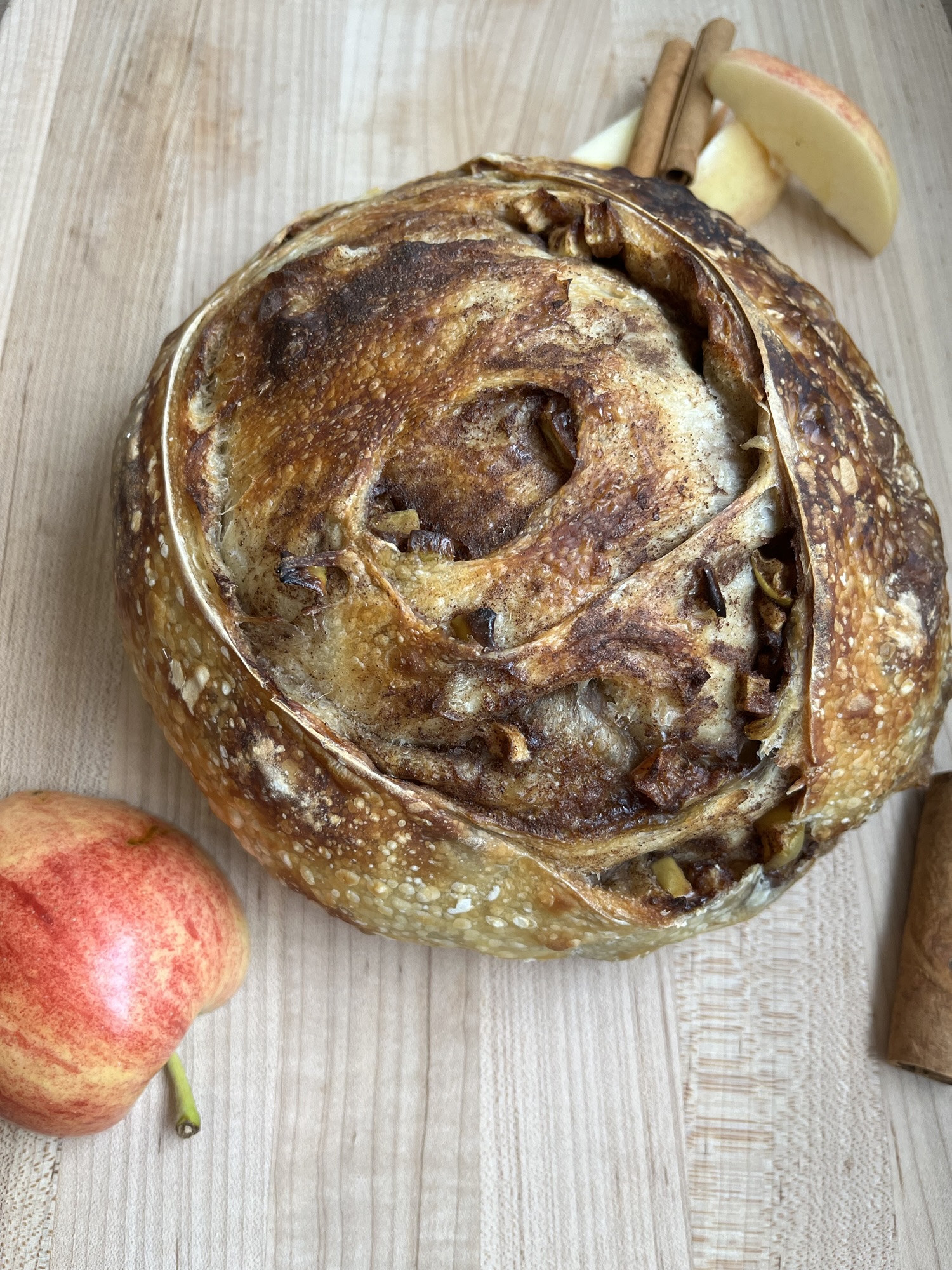
This apple cinnamon artisan sourdough loaf is everything you love about fall — cozy spices, sweet apples, and the warm scent of cinnamon filling your kitchen.
There’s just something about apples and cinnamon that instantly feels like fall to me. The way the spices fill the house with that warm, cozy aroma — it’s nostalgic and comforting all at once. Whether it’s apple pie, muffins, or a simple bowl of oatmeal, that combination of sweet apple and cinnamon is always my favorite way to welcome the season. It’s a flavor pairing that never gets old, and I couldn’t resist bringing it to life in bread form.

This apple cinnamon artisan sourdough loaf is packed with all the best fall flavors — nutmeg, allspice, cloves, and plenty of cinnamon. It’s swirled with shredded apple and cinnamon chips that melt into little pockets of sweetness throughout the loaf. It took me six tries to get it just right, but this final version was the clear winner — every one of my taste testers said, “don’t change a thing.”
The secret? Grating the apples so they blend right into the dough, and swapping a bit of the water for apple juice to boost that apple flavor even more. The result is a soft, delicious loaf that’s perfect on its own or toasted with a little butter — pure fall perfection.


Making a sourdough loaf with wet inclusions like apples can feel a little intimidating at first, but don’t worry — a few tweaks and a little patience will help you get it just right. Here are some common issues and how to handle them:
Dough feels too wet or sticky
Shredded apples naturally release a lot of moisture, so your dough might be stickier than a regular sourdough. That’s okay! A slightly sticky dough is normal. Instead of adding extra flour, try lightly flouring your hands and work surface when shaping, or use a bench scraper to help guide the dough. Too much extra flour can make the loaf dense, so embrace a little stickiness — rustic is part of the charm!
Incorporating the apples without losing structure
I have the best results with this loaf when I add the shredded apple into my dough with my flour. I almost always add inclusions during my stretch and folds, but the shredded apple released too much liquid during stretch and folds and my dough turned into a soupy mess. For the best results, add the shredded apple at the start and mix by hand. Some apples are juicer than others, so you may have to adjust the water or flour just a bit each time you make this loaf.
When to add cinnamon chips
Sugar-based inclusions like cinnamon chips can slow fermentation if added too early. I like to fold them in during the second stretch-and-fold so they’re incorporated without interfering with the dough’s rise. You’ll get that sweet cinnamon flavor perfectly distributed throughout the loaf.
Shaping challenges
Sticky dough plus juicy apples can make shaping feel tricky. Work quickly and confidently, the more you fuss with this dough, the more it’s going to tear. I like to lightly flour my counter and then preshape my dough into a boule (round) shape. Then after preshape is over, quickly shape into a batard using the caddy clasp shaping. Don’t stress if your loaf isn’t perfectly shaped — rustic, slightly irregular loaves are beautiful and full of character. This loaf tastes amazing … no one will care if it’s shaped a little funny.
Oven spring and baking
Extra moisture from the apples can weigh down the dough, which might reduce oven spring. Baking on a preheated stone or in a Dutch oven helps trap steam and give your loaf a nice rise. Score carefully: too deep and moisture escapes too quickly, too shallow and the loaf can split unevenly. Make sure to bake this loaf to 205F to make sure the inside is fully cooked. You may need to cover the loaf with foil if it starts to brown too much and bake a few extra minutes.
Sample baking schedule.
| Day 1: 8 pm | Feed sourdough starter at 1:10:10 ratio |
| Day 2: 8 am | Mix up your dough |
| 9 am | Stretch and fold #1 |
| 9:30 am | Stretch and fold #2 add cinnamon chips |
| 10 am | Stretch and fold #3 |
| 10:30 am | Stretch and fold #4 Let rest while bulk fermentation completes. |
| 3 pm | Preshape your dough (this is assuming your dough was about 75*F throughout bulk fermentation) |
| 3:30 pm | Final shape. Place dough in banneton and into fridge for cold proof. |
| Day 3: 9 am | Preheat oven and Dutch oven to 450*F |
| 9:45 am | Score dough & bake |
| 10:30 am | Bread is finished baking, let cool |
| 12 pm | Slice into that bread and enjoy a taste. |
Visual: How to do stretch and folds.

Gently pull up dough from one side of the bowl.

Fold it over into the middle. Turn the bowl a quarter turn.

Gently stretch the dough up again.

Fold over into the middle. Repeat on the remaining 2 sides.
Bulk Fermentation
Now let’s talk about the part of the process that really seems to stress people out the most: Bulk fermentation. The reason this confuses so many people is because there’s not a really easy, cut and dry explanation for when to know bulk fermentation is complete. There are so many different techniques that people use to help them determine when to end bulk fermentation.
If we’re being honest, I like to error on the side of slightly over proofed because I love the texture of my bread so much more that way. So you’re looking for your dough to have a domed top and be starting to pull away from the edges of the bowl. There should be able to see some scattered bubbles throughout your dough, although sometimes with all the inclusions, it’s more difficult to see the scattered bubbles. It should have also increased in size – the amount of rise is going to vary based on how hot or cold your dough is. And most importantly, your dough should feel light and airy. Dense and heavy dough will give you dense bread. Light and airy dough will give you light and airy bread. If your dough feels heavy and dense, let it raise longer. Don’t watch the clock … watch your dough.

Apple Cinnamon Sourdough Loaf

Equipment
- Large Mixing Bowl
- Kitchen scale
- Danish Dough Whisk
- Dutch Oven
- Bread Lame
- Banneton Basket
- Bench Scraper
Ingredients
- 100 grams sourdough starter active and bubbly
- 150 grams water
- 150 grams apple juice
- 10 grams sea salt
- 100 grams shredded apple
- 100 grams cinnamon chips (I get mine at Orson Gygi)
- 25 grams brown sugar
- 1/4 teaspoon ground nutmeg
- 1/4 teaspoon ground all spice
- 1/4 teaspoon ground cloves
Instructions
Prepare your sourdough starter
- Feed your sourdough starter at a 1:1:1 ratio about 4 hours before you want to mix up your dough. Combine 40 grams starter, 40 grams water, and 40 grams flour. Stir until everything is well combined and there are no dry bits of flour stuck to the bottom.
- Feed your sourdough starter at a 1:5:5 ratio about 12 hours before you want to mix up your dough. Combine 10 grams of starter, 50 grams of water, and 50 grams of flour. Stir until everything is well combined and there are no dry bits of flour stuck to the bottom.
- Your starter should be bubbly, at least doubled (maybe even tripled) in size, have a sweet, yeasty smell and a flat top. For best results, mix your dough up when your starter is at it’s peak.
Day 1: Prepare your dough
- Combine your active sourdough starter, apple juice, warm water and brown sugar and mix until starter is dissolved. Add shredded apple, flour, salt, nutmeg, all spice and cloves and mix until a shaggy dough forms. Depending on how juicy your apple is, you may need to add additional flour or water to get your dough to the correct texture. This dough will be a little stickier than normal, but should still be easy to work with. Don’t be afraid to adjust the flour a bit to work for you.
- Stretch and Folds: Perform a series of “stretch and folds” throughout the next 2 hours. This is how you strengthen your dough since we don’t knead it. First, wet your hands, so the dough doesn’t stick to it. Reach to the bottom of the bowl, pull the dough up and over and place it on the top of the dough. Turn the bowl a quarter turn and repeat the stretching and folding motion 4-6 times. You’ll notice the dough changes through this process. Your first set will look a little bit shaggy, but by the end you should have a nice, smooth and elastic dough. Cover the bowl and wait about 30 minutes in between each set of stretch and folds.Stretch and fold #1: 30 minutes after mixing your doughStretch and fold #2: 30 minutes later – this is when I like to add my cinnamon chips to the doughStretch and fold #3: 30 minutes laterStretch and fold #4: Optional, if your dough is still sticky or isn’t starting to hold it’s shape in your bowl you can do a fourth set to continue adding strength to the dough.
- Finish bulk fermentation: Cover the dough and let rise for 1.5-2 more hours (longer in the winter when it’s cold). You’ll know the dough is ready to shape when the dough is puffed up, jiggles when you shake the bowl, has scattered bubbles visible on the sides and top. As a reference: my kitchen usually stays around 74F and my dough typically takes about 7 hours from mixing until it’s ready to shape.
- Pre-shape: Lightly flour your counter and place your dough on the floured counter. Gently pull your dough across your counter until you’ve got a round ball. Using a bench scraper can be helpful. The goal is to introduce some tension in your dough, but we’ll be back for the final shaping in a little bit. Because of all the inclusions, it’s common for this dough to tear a bit. Try to shape it as quickly as you can. The more you mess with it, the more it will tear. If you notice it’s tearing, leave it to relax on the counter for 10-15 minutes and come back to it.
- Bench Rest: Let the dough rest uncovered on the counter for about 30 minutes. The dough will probably flatten some during this time. This allows the gluten in the dough to relax and prepares the dough for the final shaping.
- Shaping: Prepare your banneton basket. Place a kitchen towel in the bowl and flour as needed. Sprinkle a little flour on top of the dough. Using a bench scraper, lift the dough up off the counter and place it back on the countertop – floured side down. This ensures that the flour is staying mainly on the outside of the dough.For a boule (round loaf): Going around in a circle, pull the dough sideways towards you and then fold up to the top of the round. Turn 90 degrees and repeat the same process pulling the dough sideways and then folding up to the top. As you continue this process around the dough, increase the tension as you pull. Gather the bread into a circle and place into your prepared bowl. Place into your prepared banneton basket.For a batard (oval loaf): the best way to shape in a batard is using the caddy clasp for this loaf. You’re basically going to lift your boule from preshape and gently fold it in half. Then rotate the dough and fold it in half again and place in the prepared banneton basket.
- Let your dough rest in the banneton basket for about 5-10 minutes and then pinch or stitch the dough through the center.
Day 2: Baking
- Preheat your oven and Dutch oven to 450 °F for 45 minutes.
- Once preheated, pull the loaf out of the refrigerator and remove the covering. Place a piece of parchment paper on top of the dough. Flip the dough over so it is now sitting on the parchment paper.
- Scoring: Use a bread lame score the dough. While I love a decorative score, this particular loaf does best with just a single expansion score.
- Baking: Carefully remove the Dutch oven from the oven. Take the lid off and place your bread into the Dutch oven (including parchment paper – this helps with the transfer). Put the lid on and put back in the oven. Bake for 25 minutes, then remove the lid of the Dutch oven and continue baking for 20 minutes until the bread is a crackly deep brown and reaches an internal temperature of 200-210 °F. Remove the Dutch oven and place on a wire cooling rack.
- Cooling. I know it’s hard, but try to let your loaf cool for at least one hour before you slice into it.
Notes
Some of the links on this page are affiliate links. This means that if you click on a link and make a purchase, I may earn a small commission at no extra cost to you. These commissions help support the content I create and allow me to continue providing valuable information. I only recommend products and services that I trust and believe in.
Leave a Reply