
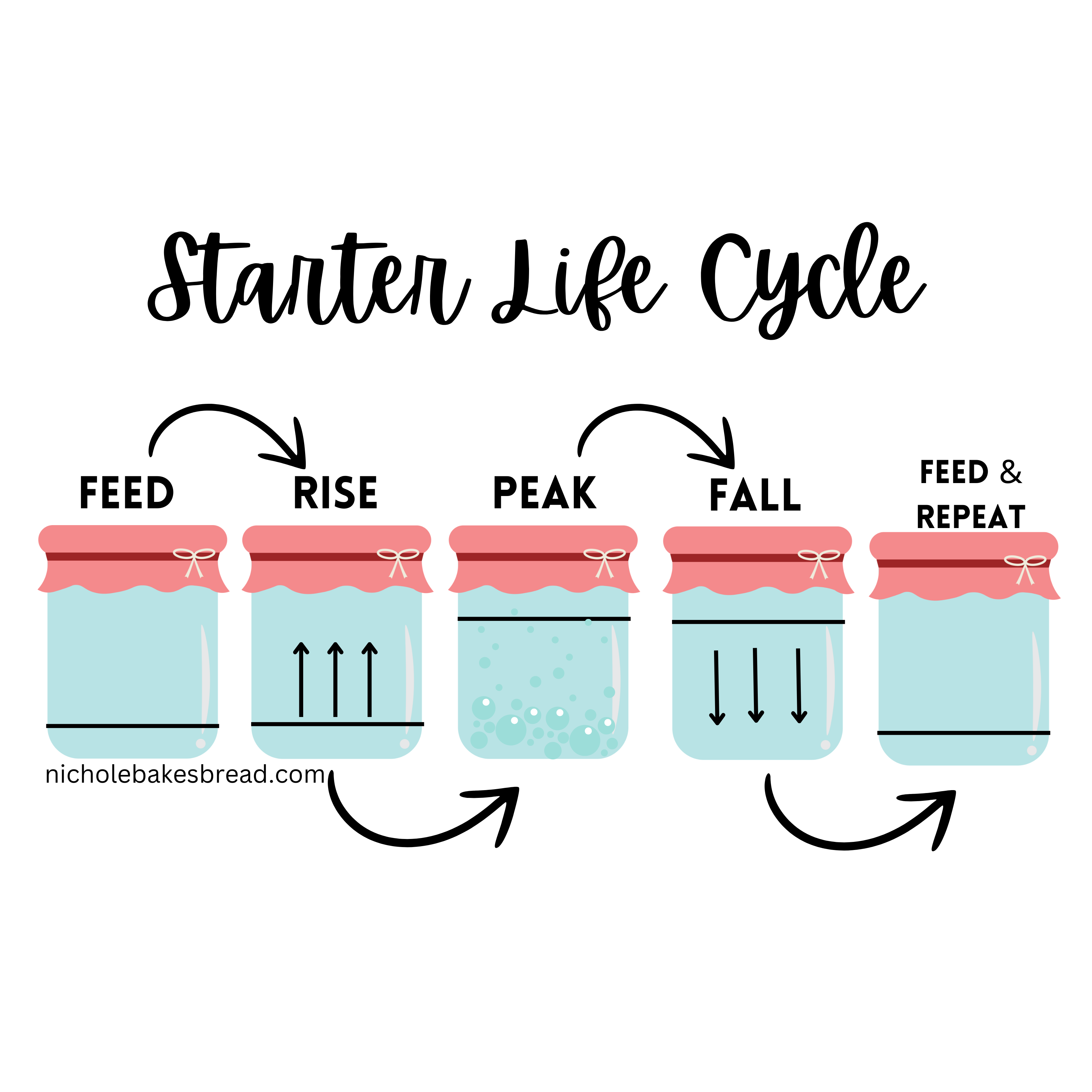
Let’s talk about the life cycle of our sourdough starter. Once you understand your starter’s life cycle, the entire sourdough bread making process is going to make so much more sense.
So here you have it … it looks something like this: FEED –> RISE –> PEAK –> (This is when you want to bake) –> FALL –> DISCARD & FEED and the cycle begins again.

Feed
Your starter is a mixture of fermented flour and water, which cultivates the wild yeast in our environment to a form that can be used to leaven bread. It’s a natural yeast, a living organism, that makes bread rise. And because your starter is a living organism, it needs to be cared for.
Feeding is the process of adding fresh flour and water to your starter to activate it for baking. Feeding your starter consistently is the key to creating and maintaining a healthy leavening agent for your bread. It only takes a few minutes.
When you feed your starter, you will transfer a small portion of your start into a clean jar and add in at least equal parts of flour and water. Mix it up until everything is combined and then watch it start to activate.
Rise
After you’ve fed your starter, the bacteria and yeast will begin to “eat” the food you gave them. As the yeast eats through that fresh flour and water, it will release carbon dioxide, which will cause your starter to rise and you’ll see air bubbles scattered throughout.
Peak
Once your starter has eaten through all that food it will hit its peak – its the highest point your starter will rise to. This is when you want to make your dough because the yeast is the strongest right now.
Fall
What goes up, must come down. Your starter will only stay at its peak for a short time. Then it will begin to fall back down to its original starting point.
Discard
Discard is simply unfed or inactive starter.
Discarding s something that a lot of people really struggle with.
Once starter has fallen it becomes “discard” and can be thrown out, saved to bake with, or fed again to become active again.
As a verb, discarding is really important in maintaining a strong and healthy starter.
It is not waste. It has a purpose. I like to think of it like trimming your hair, pruning a tree, or thinning out plants in your garden. Sometimes you have to remove some so that it can keep growing and maintain strength.
So why do we discard?
First of all, it helps to keep your starter from growing too large.
When you feed your starter, you need to feed it, at a minimum, equal parts starter, flour and water. So let’s see what would happen if you didn’t discard. And keep in mind, this is just feeding once a day, technically feeding at this ratio would require multiple feedings each day.
| Starting Amount | Feed equal parts | Ending Amount | |
| Day 1 | 25 grams | 25 g flour + 25 g water | 75 grams |
| Day 2 | 75 grams | 75 g flour + 75 g water | 225 grams |
| Day 3 | 225 grams | 225 g flour + 225 g water | 775 grams |
| Day 4 | 775 grams | 775 g flour + 775 g water | 2,325 grams |
| Day 5 | 2,325 grams | 2,325 g flour + 2,325 g water | 6,975 grams |
| Day 6 | 6,975 grams | 6,975 g flour + 6,975 g water | 20,925 grams |
| Day 7 | 20, 925 grams | 20, 925 g flour + 20, 925 g water | 62,775 grams |
If you fed your starter just once a day without discarding for a week … you would end up with more than 130 pounds of starter. Can you imagine? You would have buckets and buckets of starter really quickly if you didn’t discard.
The other reason we discard is to help keep your starter strong and healthy. If you never removed any of your start, it gets hard to take care of and feed well. And if you aren’t feeding it well, it can become overly acidic.
Your starter is essentially made up of two different microbes – yeast and lactic acid bacteria. These two microbes work together to leaven and flavor your bread. The yeast provides the rise. The lactic acid bacteria produces that delicious, tangy flavor.
When you have a healthy starter the yeast will produce carbon dioxide (air bubbles) and the lactic acid bacteria produces lactic acid.
Yeast is happiest when there’s minimal acid present. Too much acid will choke out the yeast and weaken your starter. When you discard, you’re removing some of that acid from your starter. Then when you feed your starter, the yeast can really thrive. It’s not competing with the lactic acid and is ready to eat through the fresh flour and water.
Feed
And the cycle starts all over again …

Leave a Reply